The one-sentence difference
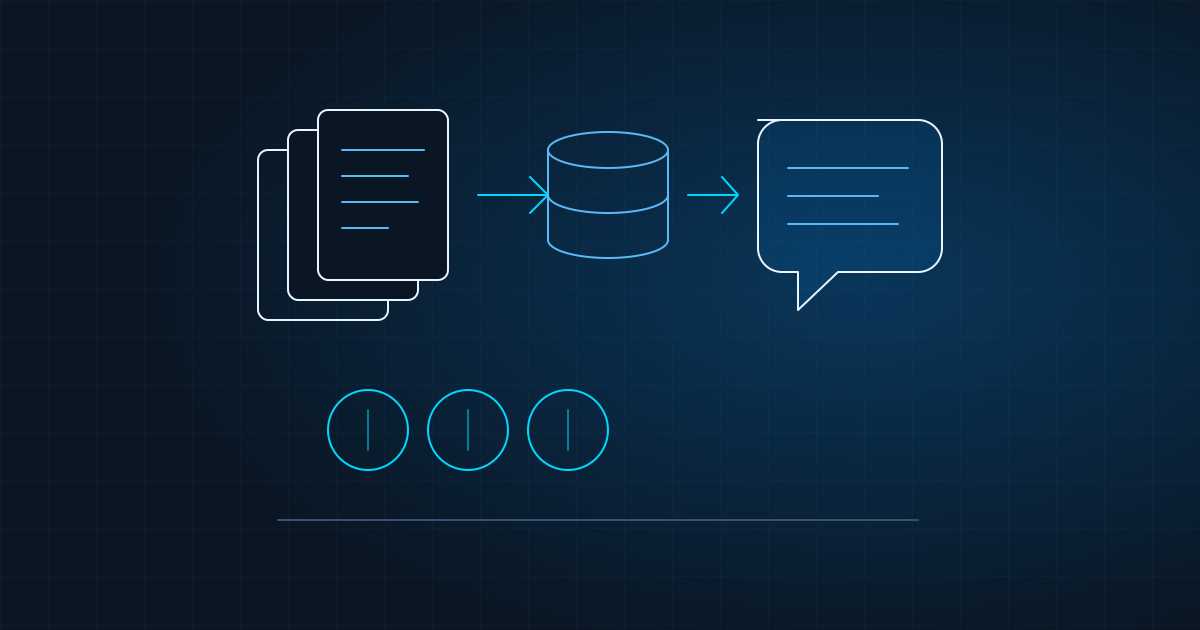
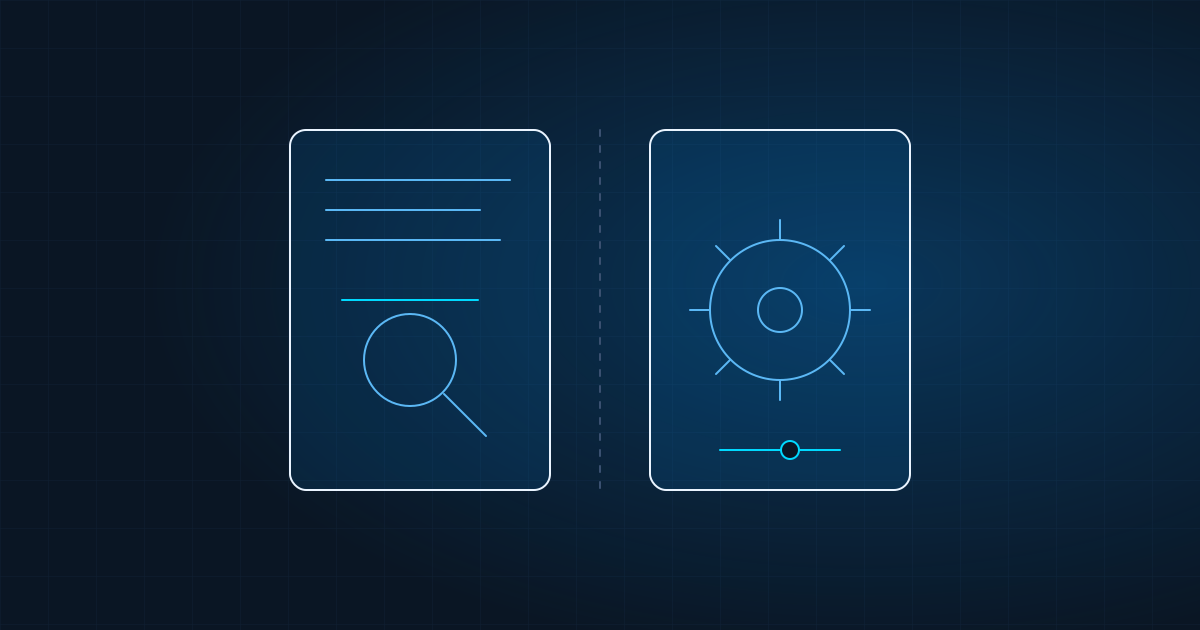
RAG gives a model the right information at the moment it answers; fine-tuning changes how the model behaves. Retrieval-augmented generation looks up relevant passages from your content and puts them in front of the model for each question. Fine-tuning continues training a model on examples so that it adopts a style, format or skill by default.
Most business problems are really about knowledge, not behaviour: the model needs to know your products, policies or documents. That is why RAG is the usual starting point, and why fine-tuning is often reached for too early.
When retrieval is enough
Choose RAG when the answers depend on information that is specific to you, changes over time, or needs to be traceable to a source.
- Support and help-centre questions that must match current policy.
- Internal knowledge search across documents, wikis and tickets.
- Anything where you want the answer to cite where it came from.
- Content that updates often. With RAG you update the document, not the model.
When fine-tuning earns its cost
Fine-tuning makes sense when the problem is consistent behaviour rather than missing facts: a fixed output format, a specific tone, domain-specific phrasing, or a narrow task you need done the same way thousands of times. It can also let a smaller, cheaper model do a task that would otherwise need a larger one.
It comes with real costs: you need a good set of training examples, you take on the work of evaluating and re-training as requirements change, and it is a poor way to teach a model facts that change. Try careful prompting and retrieval first, and measure before you commit.
Combining both
The two are not rivals. A common pattern is to use retrieval for the facts and a lightly fine-tuned model for the voice and format, for example a support assistant that always answers in your house style but pulls the actual policy text from your documents. Add the second technique only when evaluation shows the first is not enough.
Evaluate before you commit
Whichever path you pick, decide how you will judge success before building. Collect real questions, write down what a good answer looks like, and test each approach against the same set. A small, honest comparison is cheaper than a large build on the wrong assumption. If you want help setting one up, that is a core part of our AI and LLM integration work, and we explain how to measure answer quality in our guide to evaluating LLM hallucinations.
A quick decision table
Use this as a starting point, not a rule.
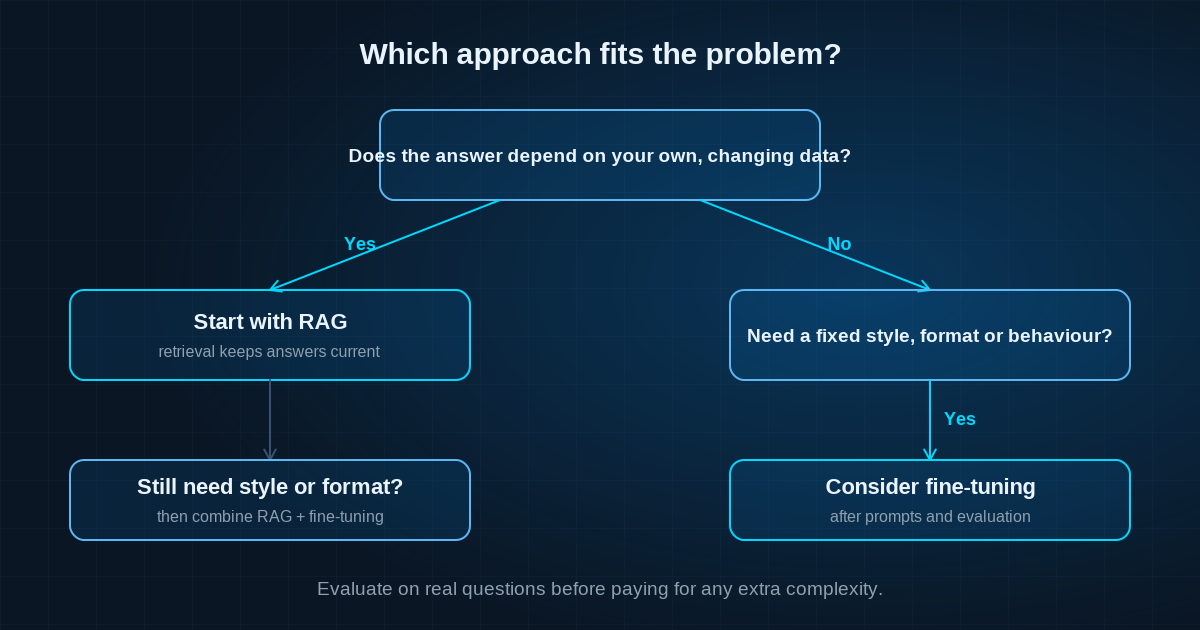
- Facts that change or need citations: RAG.
- A fixed format, tone or narrow repeated task: fine-tuning, after prompting is tested.
- Both facts and a consistent voice: RAG first, then consider adding fine-tuning.
- Not sure: build a small RAG prototype and measure it against real questions.
Frequently asked questions.
- Is RAG better than fine-tuning?
- Neither is better in general. RAG is usually the better first choice when answers depend on your own, changing information. Fine-tuning is better for consistent behaviour or format. Many systems use both.
- Can fine-tuning teach a model my company's knowledge?
- It can absorb some of it, but it is a poor fit for facts that change, because you would need to re-train to update them. Retrieval keeps knowledge current and lets answers point to sources.
- Which is more expensive to maintain?
- Fine-tuning usually carries more ongoing effort, since changes in requirements mean new training data and re-evaluation. RAG's upkeep is mainly keeping the documents and the index current.