
Why vague briefs produce vague quotes
If you ask three agencies to quote on "a new website", you will get three very different numbers, because each is quietly guessing a different project. The quotes cannot be compared, the cheapest one is usually the one that assumed the least, and the real scope gets discovered, and paid for, halfway through.
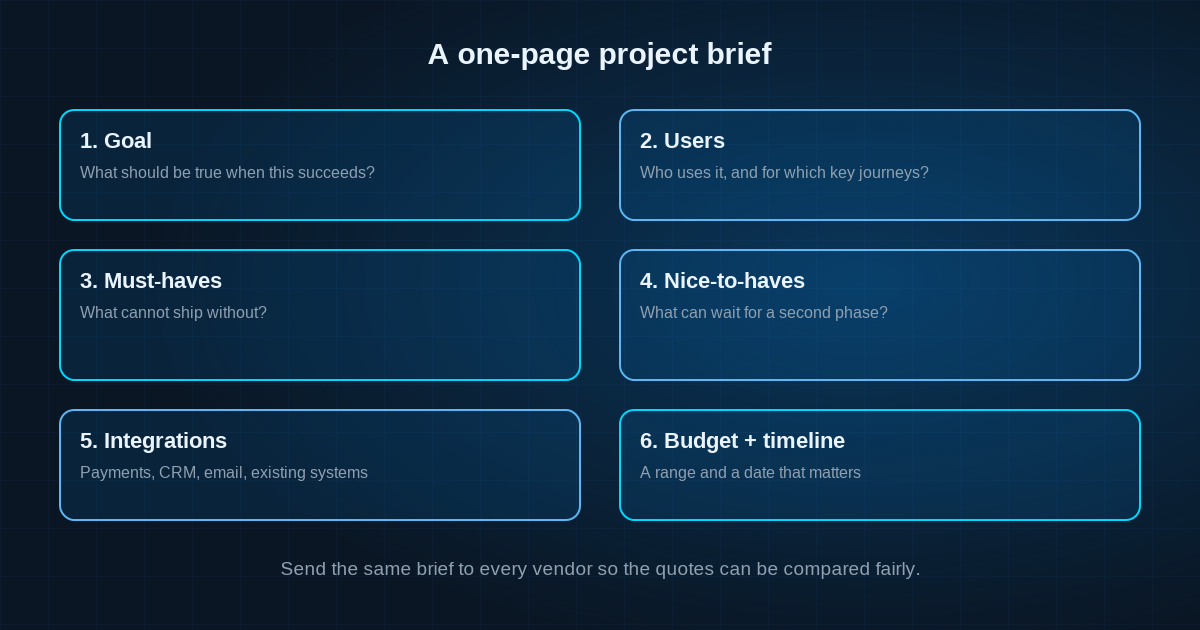
A one-page brief fixes most of this. It does not need to be technical. It needs to say what you are trying to achieve, for whom, and what is and is not in the first release, so that everyone is quoting on the same thing.
Start with goals and how you will measure them
Write down the business outcome, not the feature list. "Increase qualified enquiries" and "let customers book without calling" are goals; "add a carousel" is not. Attach a measure you already track, such as enquiries per month or booking completion rate, so you can tell afterwards whether the project worked. A good partner will ask about these in the first call, and a brief that already has them saves a round of questions.
Describe your users and their key journeys
List the two or three kinds of people who will use the site and the one or two things each of them must be able to do. For example: a first-time visitor finds your services and sends an enquiry; a returning customer logs in and reorders; your team updates prices without a developer. Journeys like these drive the design and the cost far more than a page count does.
Separate must-haves from nice-to-haves
Split your wish list in two. Must-haves are what cannot go live without. Nice-to-haves can wait for a second phase. Being strict here is the single most effective way to control cost and timeline, and it gives you something to trade when the budget is tight.
List integrations and constraints
Integrations are where hidden cost lives. List anything the site must talk to: payment providers, a CRM, email marketing, booking or inventory systems, analytics. Note existing constraints too, such as a brand guide, a required hosting provider, accessibility or compliance requirements, and content that has to be migrated from an old site.
Share a budget range and a date that matters
Many people withhold their budget, hoping to get a better price. In practice, sharing a realistic range lets a vendor propose what is achievable inside it and be honest if it is not. Do the same with timing: tell them if a launch, campaign or event sets a real deadline. Then compare quotes on the same basis. If you would like to talk it through, our web platform engineering team is happy to review a draft brief; you can send it over here.
- One-page brief checklist: goal and measure, users and journeys, must-haves, nice-to-haves, integrations and constraints, budget range, and any fixed date.
- Send the same brief to every vendor and ask each to state their assumptions.
- Prefer the quote that explains what it excludes over the one that looks cheapest.
Frequently asked questions.
- How detailed should a project brief be?
- One to two pages is enough to get comparable quotes. Cover goals, users and journeys, must-haves, nice-to-haves, integrations, budget range and timeline. Detail beyond that can be worked out together in a discovery phase.
- Should I share my budget with agencies?
- A realistic range usually helps. It lets a vendor propose what fits and flag if your expectations and budget do not match, instead of guessing and quoting something unusable.
- What is the difference between must-haves and nice-to-haves?
- Must-haves are the things the site cannot launch without. Nice-to-haves are improvements that can wait for a later phase. Separating them is the best way to control cost and delivery time.